You've opened a dozen tabs for remote project manager jobs, only to discover that “remote” means three office days, a specific U.S. state, or an on-call rotation that starts after dinner. The listing may look ideal until you reach the location policy, interview with the hiring manager, or ask when the team works together.
The practical answer isn't applying faster. It's learning to identify the operating model behind the label, then showing evidence that you can run delivery inside it. A strong candidate can explain overlap hours, decision rights, handoffs, risks, and outcomes before an employer has to ask.
Table of Contents
- The Remote PM Job Market in 2026
- Reading Remote Job Postings Like a Pro
- Optimizing Your Resume and LinkedIn for Remote PM Roles
- How Virtustant Jobs Can Help
- Building a PM Portfolio That Proves You Can Ship
- Where to Find Remote Project Manager Jobs
- Outreach and Networking That Gets Replies
- Interview Prep, Negotiation, and Your 90-Day Plan
The Remote PM Job Market in 2026
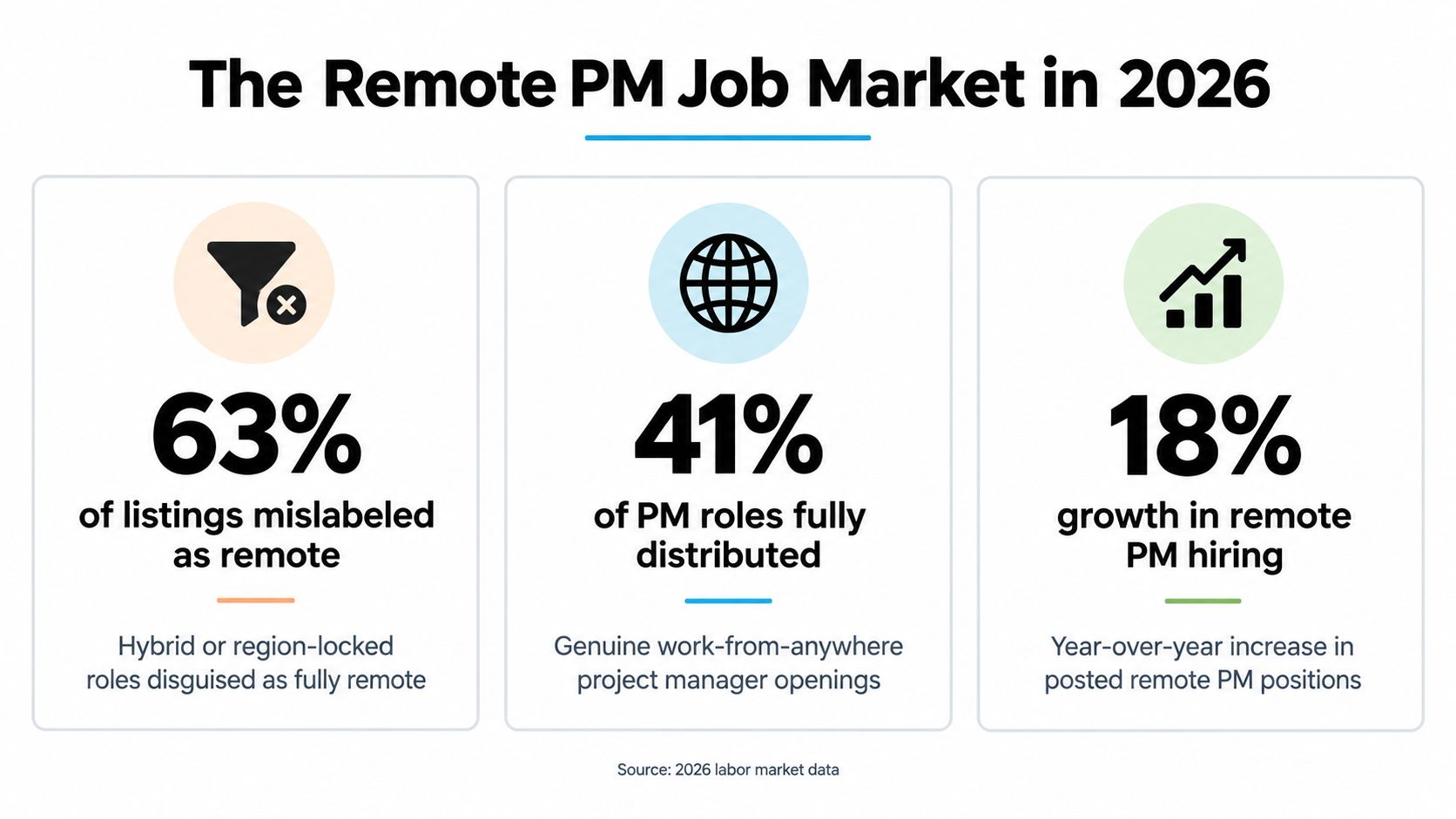
A posting can say “remote” while still requiring fixed overlap hours, regional payroll eligibility, or regular travel. The market rewards project managers who classify those conditions before applying, then show they can keep delivery moving across borders and time zones.
Project management is a broad field. The U.S. Bureau of Labor Statistics describes approximately 1.1 million project management specialists in 2025, with employment projected to grow 7% between 2025 and 2035. The same source estimates roughly 73,200 additional positions and about 77,000 openings per year when growth and replacement demand are combined.
Demand is spread across industries, but remote suitability is not. Professional, scientific, and technical services employ 28% of project management specialists, construction employs 22%, and manufacturing employs 7%, according to the same source. A software delivery manager can coordinate repositories, tickets, documentation, and releases from another country. A construction PM still needs dependable access to a physical site.
Where remote work fits best
Prioritize roles where the work product exists mainly online:
- Software and SaaS: Product releases, sprint coordination, integrations, migrations, and platform improvements can run through Jira, Linear, GitHub, GitLab, Notion, and video calls.
- Web and mobile agencies: Client approvals, design handoffs, development dependencies, content reviews, and launch checklists benefit from a visible digital workflow.
- Consulting and professional services: Distributed consultants can manage client accounts when the PM controls scope, decisions, risks, and reporting.
- Finance and administrative operations: Document-driven processes may support location flexibility, subject to regulatory, security, and regional requirements.
Construction and manufacturing require a different filter. Inspections, suppliers, production facilities, and site visits can make fully distributed work impractical, even when planning and reporting happen online.
Hybrid work remains more common than fully remote work. A 2024 summary reported that 28.2% of workers operated under hybrid arrangements, while approximately 12% remained fully remote. Its project-management figures showed 61% of professionals worked remotely at least some of the time, while 39% worked in person five or more days per week (Safeture's remote-work summary).
Practical rule: Treat “remote” as a prompt to inspect overlap hours, travel, employment eligibility, and async practices, not as proof that you can work from anywhere.
Classify the operating model first. Then check time-zone and employment constraints, and tailor your proof with relevant codebase, workflow, or template projects. That sequence protects your time and makes each application more credible.
Reading Remote Job Postings Like a Pro
You find a promising remote project manager role, then notice the required meeting window starts before your local workday. Another posting allows international applicants but expects quarterly travel and rapid responses during releases. The label creates interest. The operating details determine whether the job fits.
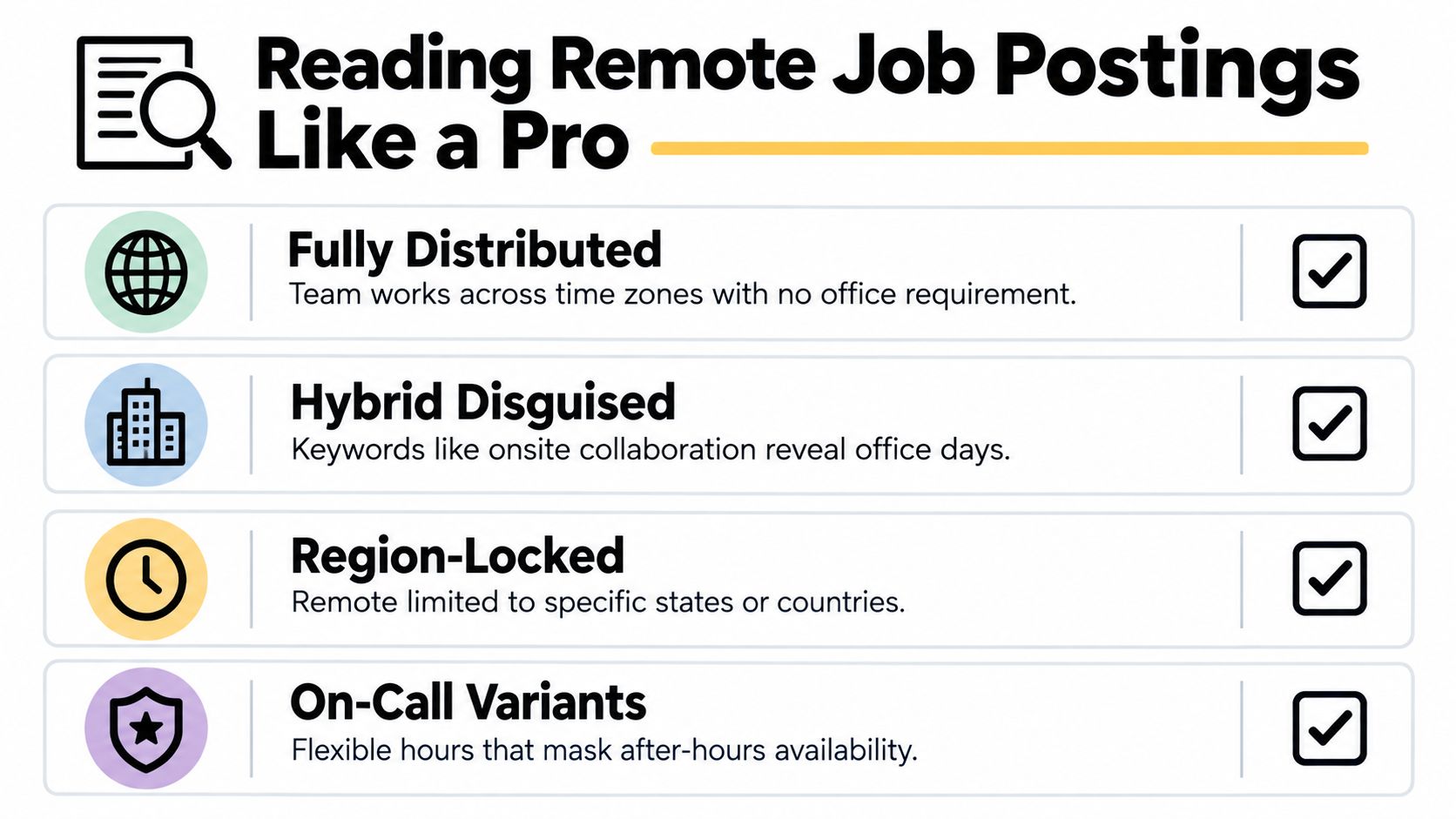
Phrases such as remote within approved locations, core collaboration hours, quarterly travel, flexible availability, and must be authorized to work in reveal more than the word “remote.”
Use a five-question reality check
Before adapting your resume, answer these questions from the posting, company careers page, and recruiter message:
- Where can the employee legally work? Separate work-from-anywhere language from approved countries, states, or payroll regions. Check whether contractor and employee eligibility differ.
- How much overlap is expected? Look for core hours, recurring stand-ups, customer windows, and executive meetings. A location-flexible role may still require a fixed working day.
- What travel is hidden in the wording? “Occasional onsite collaboration” could mean one planning session or regular visits. Ask about the normal cadence and who pays for travel.
- What does “flexible” mean after hours? Check for incident response, customer escalation, release coverage, or weekend availability. Flexible hours do not automatically mean unlimited availability.
- How mature is asynchronous work? Written processes, clear decision ownership, documentation expectations, and meeting principles usually indicate better remote design than a listing built around constant availability.
This filtering matters because remote hiring has become less consistent. HR Dive reports that 48% of surveyed HR professionals included remote or hybrid work in their talent-acquisition strategy, down from 56% in the prior survey. The same source says 58% of surveyed U.S. workers were fully on-site in 2024, up from 53% in 2023. Genuine distributed roles remain available, but employers use the label unevenly.
Rewrite evidence, not responsibilities
A weak bullet says:
Managed software projects and communicated with developers.
A stronger version says:
Coordinated a distributed software release through Jira and GitHub, maintaining dependency ownership, written status updates, and acceptance criteria through launch.
The second version shows how you created visibility without relying on hallway conversations. It also gives a recruiter concrete terms to match against the role.
Another example:
- Before: Scheduled meetings and tracked project tasks.
- After: Replaced recurring status meetings with a weekly written forecast, decision log, and blocker queue, giving stakeholders one searchable delivery record.
Do not claim an improvement you cannot verify. Describe the artifact, scope, stakeholders, and decision you managed when you lack a precise outcome. That evidence is more credible than an invented performance figure.
Gartner data from the same HR Dive survey found that 24% of candidates cited location flexibility as a reason for selecting an offer, compared with 35% citing time-based flexibility. Use that distinction when assessing a role. Predictable hours, autonomy, and manageable overlap may matter more than the broadest “work from anywhere” claim.
Applying faster rarely helps. Identify the operating model behind the label, then tailor your proof with a relevant codebase, workflow, or template project.
Optimizing Your Resume and LinkedIn for Remote PM Roles
A remote-ready resume should make distributed delivery visible in the first third of the page. A hiring manager needs evidence that you can coordinate people who work across borders, handle limited overlap, maintain a dependable record of decisions, and expose risk before a deadline becomes a surprise.
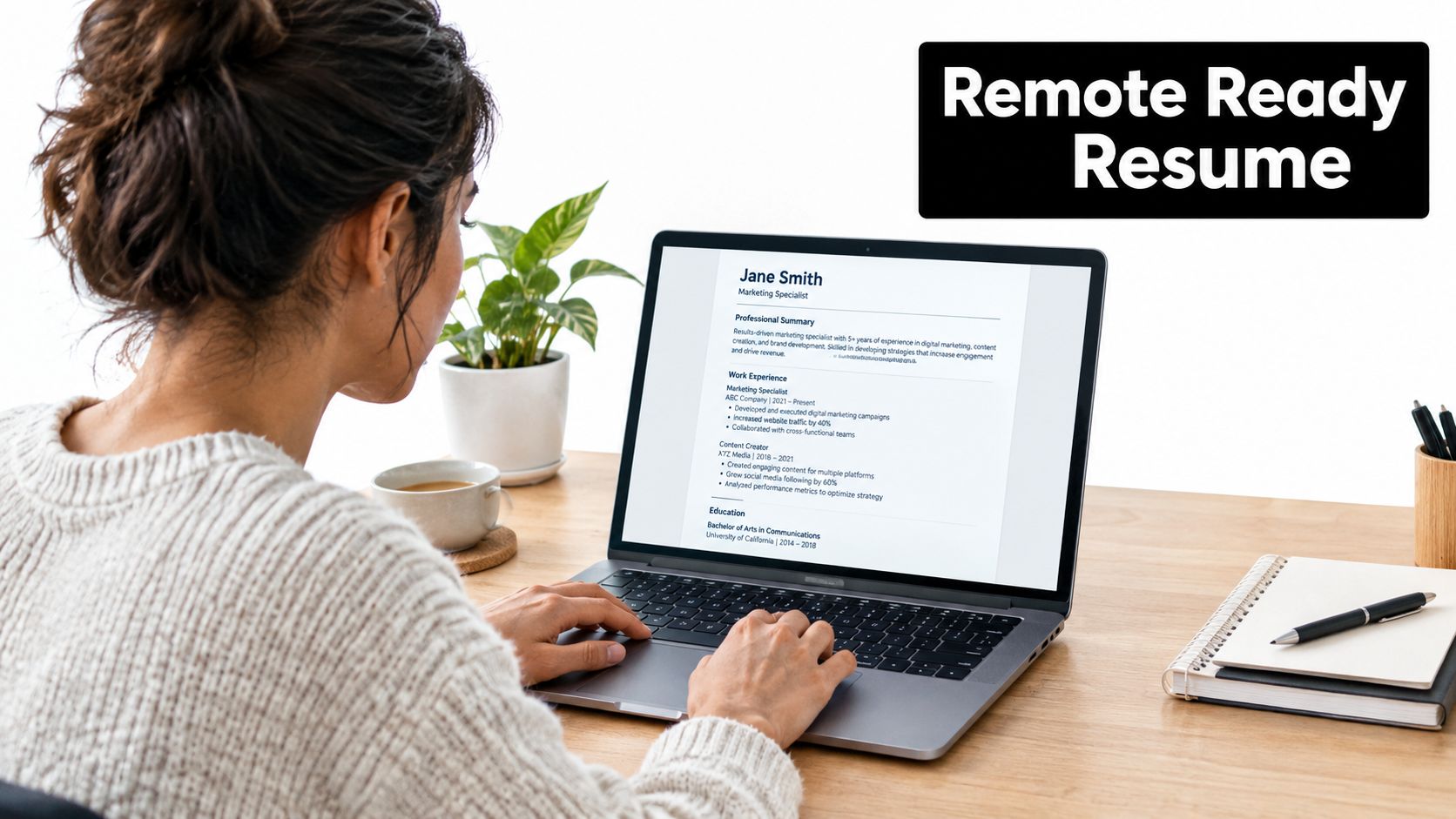
Start with a headline that combines the domain, delivery type, and operating strength. “Project Manager” is accurate but forgettable. “Technical Project Manager | SaaS and Mobile Delivery | Async Coordination Across Time Zones” tells a recruiter what you manage and how you work.
Your summary should answer three questions quickly: what you deliver, who you coordinate, and how you keep work moving. Mention Jira, Linear, Asana, GitHub, GitLab, Notion, Confluence, Slack, or Microsoft Teams only when you have used them meaningfully. Tool names can help with search matching, but the workflow behind them earns the interview. State the time-zone model when relevant, including overlap hours, handoff routines, and whether travel or scheduled onsite work was part of delivery.
Turn ordinary experience into proof
Consider a developer-adjacent candidate who coordinated a Flutter ecommerce app from a starter codebase. The resume should show the operating work rather than just claim app management:
Led backlog shaping, design handoffs, QA triage, and store-submission readiness for a Flutter ecommerce build, using a dependency map and release checklist to coordinate engineering and client review.
This bullet identifies the codebase, delivery stages, artifacts, and stakeholders. It also makes clear that the PM connected technical work to a usable release without claiming to have written every line of code.
Describe projects with the same level of specificity across the resume. Name the artifact you maintained, the decision you managed, and the people or functions involved. If you lack a verified outcome, describe the scope and delivery evidence instead of inventing a percentage or time saving. A launch checklist, decision log, acceptance criteria, risk review, or written forecast gives an interviewer something concrete to examine.
Review this collection of resume bullet point examples to pressure-test whether each bullet begins with a delivery action, outcome, or concrete artifact rather than a routine responsibility.
Make LinkedIn support the resume
Use the About section as a concise operating manual. Explain how you run kickoff meetings, document decisions, handle blockers, and communicate across time zones. Mention how you classify remote roles before applying: fixed overlap, flexible overlap, travel expectations, and the level of async documentation the team already uses.
Add a Featured item linking to a portfolio, sample delivery board, or sanitized project brief. A small portfolio can include a real codebase project, a reusable planning template, or a release workflow that demonstrates how you turn incomplete information into coordinated work. Remove client-sensitive details, credentials, and proprietary data.
Your activity does not need to become a daily performance. Publish useful observations about release planning, async status updates, scope control, or technical handoffs. Comment thoughtfully in product and developer communities. Specific work gives recruiters more to assess than generic claims about leadership.
Before applying, check that your materials show:
- Distributed coordination: Time zones, overlap hours, handoffs, async communication, or cross-border stakeholders.
- Delivery control: Milestones, dependencies, risks, scope decisions, and acceptance criteria.
- Technical context: The products, platforms, codebases, or integrations you managed.
- Evidence: A shipped artifact, decision, launch, operational change, or result you can discuss.
- Posting language: Relevant terms copied accurately from the vacancy, without keyword stuffing.
How Virtustant Jobs Can Help
Candidates in Latin America often face a fragmented search. One board may have attractive remote labels but unclear time-zone expectations, while another may show jobs without enough information about tools, language requirements, or hiring geography.
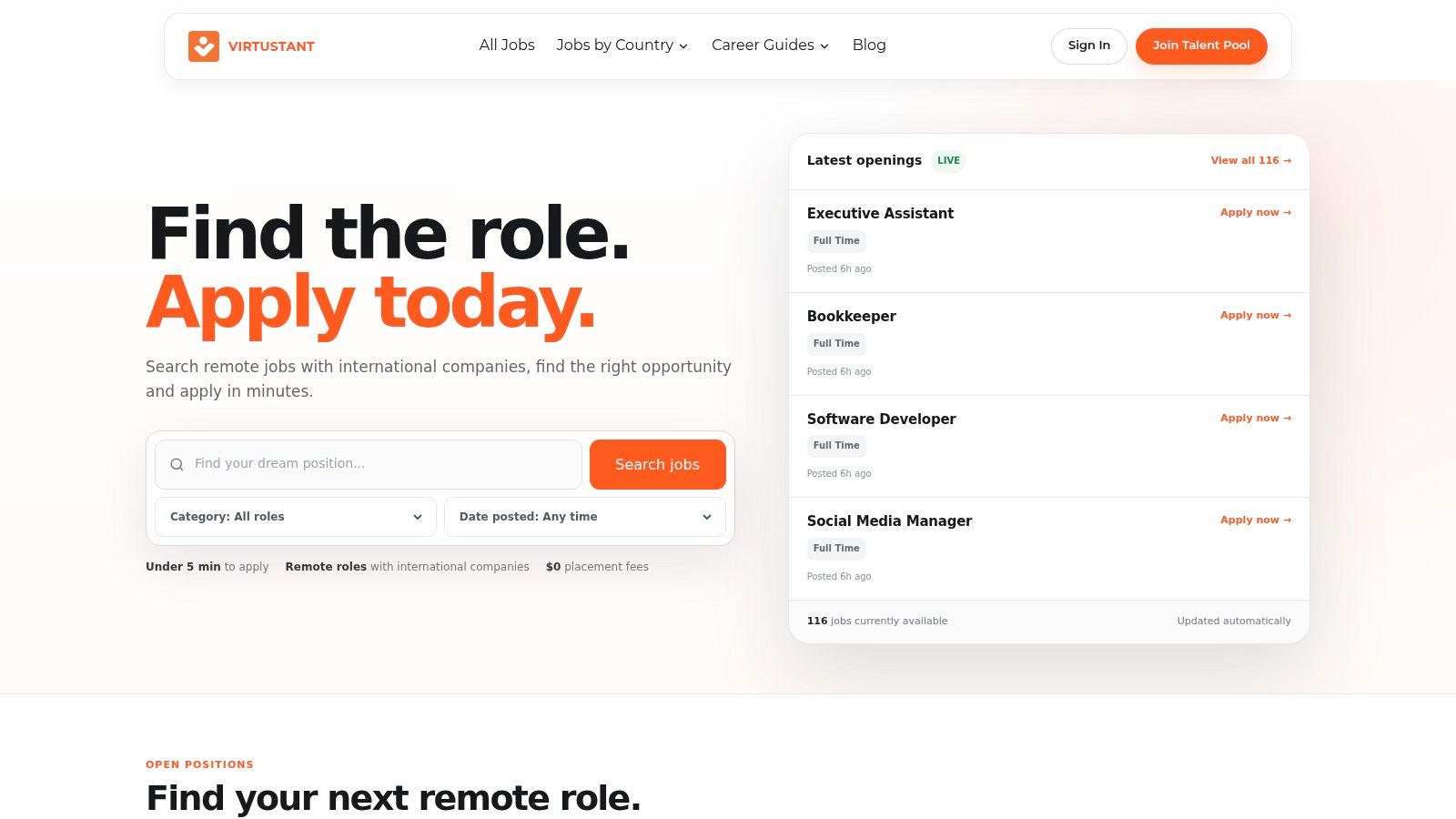
Virtustant Jobs focuses on remote opportunities for candidates across Latin America. Its listings span administrative support, customer service, sales, marketing, design, ecommerce, finance, legal, technical, operations, and project management roles. Postings typically specify responsibilities, experience, software, schedules, and language requirements, with examples such as QuickBooks, Excel, EST hours, and advanced English.
When the platform is a good fit
Virtustant is most useful when you want a LATAM-oriented search, clear cross-border expectations, and a short standardized application. The site includes Easy Apply, candidate accounts, and an optional talent pool for consideration when suitable future roles appear. Some listings clarify full-time or part-time status and whether payment is handled in USD or local currency.
That doesn't remove the need for due diligence. Confirm employment or contractor status, overlap hours, travel, payment terms, and reporting lines before accepting an offer. Treat the platform as a focused discovery channel, not a substitute for evaluating the employer.
Compared with a broad aggregator, the advantage is contextual detail and regional relevance. Compared with a global remote board, the likely trade-off is a narrower geographic focus. Use it early in your routine if you're based in Latin America and want roles aligned with U.S. business hours, bilingual work, or cross-border client delivery.
Building a PM Portfolio That Proves You Can Ship
The same Flutter ecommerce starter, CRM module, and Unity reskin projects from your resume can become useful portfolio case studies. The difference is the evidence: show how you made decisions, coordinated work across borders, and moved a deliverable from an unclear request to acceptance.
Build two or three case studies around realistic digital delivery. Choose projects that let you show different operating conditions, such as limited overlap hours, distributed contributors, or an async handoff between design and development. A codebase or template project works if you label it clearly and explain what you managed yourself.
Use the same six-part structure for each project:
- Context: What did the client, product owner, or fictional stakeholder need?
- Scope: What was included, excluded, and dependent on another workstream?
- Operating model: Which tools, overlap hours, meeting rules, handoff practices, and decision rights did you establish?
- Control artifacts: Publish a sample work breakdown structure, dependency map, risk register, decision log, and weekly status update.
- Obstacle: Describe a realistic blocker, such as an incompatible module, missing asset, unclear acceptance rule, or late stakeholder decision.
- Outcome: State what was delivered, tested, approved, or documented. Do not invent a business result.
A portfolio should show how remote work functioned, not merely that the project happened online. PMI research on virtual teams found that team performance varied with how effectively the model was supported, including schedule, budget, quality, and client-expectation measures. Show the practices that created that support: written decisions, clear ownership, usable handoffs, and escalation rules.
Make the portfolio readable in minutes
Put the project objective at the top, followed by a simple delivery diagram. Link to sanitized screenshots of a board, risk log, or decision record. State which parts you personally managed and which technical choices belonged to developers or designers.
Include a “week one” kickoff note, a mid-project risk escalation, and a final acceptance checklist. These artifacts give an interviewer specific material to question. They also demonstrate project management as a control system rather than a collection of meetings.
Your portfolio can include a small operating guide for cross-border delivery. Show the agreed overlap window, the response expectation for urgent issues, the channel for decisions, and the format for async updates. If travel or client workshops were part of the scenario, record that requirement instead of presenting the role as fully location-independent.
AI tools can organize notes, draft a first status report, or compare requirements against acceptance criteria. Keep judgment and accountability with you. This guide to AI tools for content generation can support responsible workflow design, but your portfolio should identify what you reviewed, changed, and approved.
For outreach, keep the message specific:
Hi Maya, I saw your team is coordinating a distributed product release. I manage technical delivery through dependency maps, written forecasts, and clear acceptance criteria. I've attached a short case study showing that workflow around a mobile app project. If you're hiring for delivery support, would a brief conversation about your current release process be useful?
The message gives context, evidence, and a small ask. It also makes the relevant operating model visible before the reader decides whether to reply.
Where to Find Remote Project Manager Jobs
No single channel wins on every criterion. Remote-first boards usually offer better location signals, general aggregators offer breadth, and LinkedIn offers access to recruiters and hiring managers. Community channels can surface work before a formal search becomes crowded, but they require reputation and judgment.
| Channel | Remote Filter Quality | Competition | Best For |
|---|---|---|---|
| Remote-first job boards | Usually clearer, but verify eligibility | High | Candidates who need distributed-work filters |
| General aggregators | Inconsistent and often broad | High | Discovering employers and role variations |
| Depends on employer accuracy | High | Recruiter access, referrals, and company research | |
| Company career pages | Often strongest source detail | Moderate | Targeting remote-first software and services firms |
| PM and developer communities | Informal and uneven | Variable | Relationship-led opportunities and niche delivery work |
Start with company career pages for software firms, agencies, SaaS businesses, and digital consultancies whose products can be delivered online. Search for project, delivery, implementation, program, and operations roles, not only “remote project manager.” Employers may use different titles for nearly identical work.
A practical daily routine can fit into one focused session:
- First pass: Review saved searches and alerts, discarding roles with unacceptable location or schedule restrictions.
- Second pass: Inspect the employer's careers page, product, customer base, and working-hours language.
- Third pass: Tailor the resume headline and two or three bullets to the role's delivery problem.
- Fourth pass: Submit the application with a relevant portfolio case study.
- Final pass: Contact a credible employee or recruiter with a concise, role-specific note.
Configure alerts around tools and domains, not just the title. “Technical project manager,” “implementation manager,” “delivery manager,” “web project manager,” and “product operations” can uncover suitable work that a single title misses.
Prepare for the interview before applying
Remote PM interviews often test how you operate when information is incomplete. Practice answering these scenarios:
- A developer is blocked in one time zone, but the subject-matter expert is offline. What do you document, who do you notify, and when do you escalate?
- A stakeholder changes acceptance criteria near release. How do you expose the impact and obtain a decision?
- A kickoff includes people who won't share working hours. Which agreements do you document before the first sprint?
- A take-home assessment asks for a plan. Can you show assumptions, dependencies, risks, decision points, and a definition of done without producing a decorative timeline?
Ask employers about overlap, meeting expectations, travel, escalation coverage, and how decisions are recorded. Negotiation starts before the offer because these terms shape the actual job.
Outreach and Networking That Gets Replies
Remote hiring depends heavily on written trust. Your first message is already a work sample. If it's vague, long, or difficult to answer, the recipient has little reason to imagine you creating clarity inside a project.
PMI survey data identifies engaging remote participants as the leading challenge, selected by 76% of respondents (PMI's research on leading virtual teams). GitLab's all-remote guidance recommends asynchronous workflows, optional meetings where possible, recorded and documented discussions, and explicit agendas. Model those habits in every message.
Use three messages with clear boundaries
After applying to a role
Subject: Technical delivery support for [project or team]
Hi [Name], I applied for the [role] position because my experience matches your need for [specific delivery problem]. I coordinate distributed work through written forecasts, dependency tracking, and decision logs. This short portfolio example shows how I handled [relevant project type]. I'm happy to answer questions asynchronously if that's easier.
Reconnecting with a former colleague
Hi [Name], I'm exploring remote delivery and project-management roles focused on [domain]. I remember working with you on [specific context], especially the way we handled [specific challenge]. If you hear of a team needing someone who can coordinate technical work across time zones, I'd appreciate an introduction. No action is needed if nothing comes to mind.
Contributing in a community
I've been documenting a lightweight workflow for coordinating mobile releases across distributed contributors. The useful parts have been a dependency map, one accountable owner per task, and a searchable decision log. If anyone is dealing with late handoffs or unclear acceptance criteria, I'm happy to share the template.
Avoid asking a community for “any remote jobs.” Offer something useful first, then state the type of opportunity you're prepared to discuss.
A manageable weekly cadence includes targeted applications, a small number of thoughtful direct messages, one useful community contribution, and follow-ups on prior conversations. Follow up once after enough time for the recipient to process the message, then move on unless they invite continued contact. Your aim is not maximum volume. It's a record of relevant, respectful interactions.
Use LinkedIn deliberately. This guide to growing LinkedIn followers is useful for thinking about consistent professional visibility, but don't turn activity into a substitute for evidence. A concise post showing a risk register or explaining a difficult handoff can create more credibility than repeated declarations that you're open to work.
A 90-day outreach sequence
During the first phase, refine your positioning and publish one or two credible artifacts. In the middle phase, target employers and communities where your technical domain is relevant. In the final phase, turn conversations into interviews by bringing a portfolio case study and asking precise questions about the operating model.
The common failures are predictable. Candidates apply to every “remote” listing without checking eligibility, describe tools without outcomes, send generic messages, and treat meetings as proof of coordination. Stronger candidates show the opposite: they filter carefully, write clearly, document decisions, and make it easy to verify how they work.
Interview Prep, Negotiation, and Your 90-Day Plan
Interview preparation should center on operating decisions, not polished definitions. For a blocked task, explain how you establish the facts, record the dependency, identify an owner, communicate the impact, and set the next review point. For a distributed kickoff, explain how you document time zones, decision rights, channels, escalation rules, dependencies, and the definition of done.
A take-home exercise deserves the same treatment as a real project. State assumptions, identify unknowns, create a milestone view, flag risks, and distinguish decisions from tasks. Don't bury a weak plan under elaborate formatting. Interviewers are looking for judgment and visibility.
Bring your portfolio into the conversation. Walk through one case study in this order:
- Situation: What needed to be delivered?
- System: How did you organize people, information, and dependencies?
- Tension: What changed or became blocked?
- Decision: What did you recommend, and who owned the final call?
- Evidence: Which artifact proves the work was controlled?
- Result: What was accepted, launched, or learned?
Negotiation should cover more than compensation. Confirm geographic eligibility, employee or contractor status, required overlap, meeting load, travel, after-hours coverage, equipment expectations, and payment currency or method where relevant. Ask the employer to describe a normal week and a difficult week. The contrast often reveals more than the job description.
Useful scripts include:
I'm interested in the role. Before we finalize terms, could we confirm the required overlap hours, travel expectations, and whether release support includes evenings or weekends?
The responsibilities align closely with my technical delivery experience. Based on the scope and the cross-border coordination required, is there flexibility in the offer?
I'm comfortable with the proposed schedule. I'd like the agreement to state the expected overlap window and travel cadence so both sides have the same operating assumptions.
Your 90-day roadmap
Weeks one and two: Rewrite the resume and LinkedIn profile around distributed delivery. Select two portfolio projects, publish the core artifacts, and define your target industries, time zones, and minimum working conditions.
Weeks three through six: Build saved searches, inspect company career pages, apply selectively, and send role-specific outreach. Track each application in a simple sheet with location rules, overlap hours, contact, follow-up date, and outcome.
Weeks seven through twelve: Prepare scenario answers, refine the portfolio from interview feedback, ask direct questions about operating practices, and negotiate the complete work arrangement rather than only the headline offer.
The main pitfalls are avoidable. Don't assume remote means global, don't hide schedule constraints, don't claim outcomes you can't support, and don't confuse tool familiarity with delivery leadership. The candidate who can explain how work moves across borders, how decisions become searchable, and how risks reach the right person has a practical advantage.
If you're building a portfolio around software, mobile, website, or game delivery, explore Code Market's curated catalog of codebases, templates, scripts, and modules at Code Market. Choose one realistic project, document the delivery system around it, and use that evidence in your next targeted application.
This article was inspired by Outrank.